All posts by ania ziemba

.

Why do leaves change color in the fall season?

In some areas of the world, the weather changes in the fall, making the air turn cold. During this time, many leaves also change colors. Why does this happen?
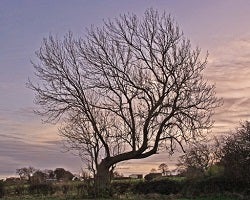
image of dormant tree

Deciduous trees drop their leaves in winter. Image by Paul Buckingham.

First let’s think about why some trees drop their leaves before winter. In the winter, it would take a lot of energy and water for plants to keep their leaves healthy. But winter is cold, dry, and usually there isn’t much sun (which helps give plants energy). So, instead of trying to keep their leaves, some plants drop their leaves and seal the spots on their branches where the leaves had been attached.

How is this related to what makes leaves colorful?

Leaves are colored by molecules called pigments. The pigment that causes leaves to be green is chlorophyll. Chlorophyll is important for plants to make food using sunlight. During spring and summer when there is plenty of sunlight, plants make a lot of chlorophyll.

In autumn when it starts to get cold, some plants stop making chlorophyll. Instead, those plants break down chlorophyll into smaller molecules. As chlorophyll goes away, other pigments start to show their colors. This is why leaves turn yellow or red in fall.
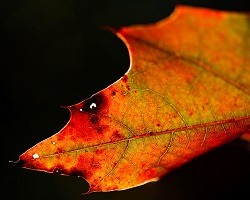
orange colored leaf

In fall, plants break down and reabsorb chlorophyll, letting the colors of other pigments show through. Image by Sander van der Wel.

The color change usually happens before the leaves fall off of the tree. Why might that be? It takes a lot of energy to make chlorophyll. If the plants break down the chlorophyll and move it out of their leaves before the leaves fall, plants save energy. The plants can reabsorb the molecules that make up chlorophyll. Then, when it’s warm and sunny enough to grow again, the plants can use those molecules to remake the chlorophyll. That way the plants don’t have to make chlorophyll from scratch.

There are other pigments in leaves called carotenoids. Carotenoids are yellow and orange. Anthocyanins are other plant pigments that are only made in the fall. These pigments cause red, pink, or purple colors. Anthocyanins also protect leaves from being eaten or getting sun burned.

So the different colors in leaves are caused by changes in the pigments. When the weather changes, some plants break down all the green pigment. This lets beautiful yellows, oranges, and reds come through in the fall.

-Post made by Ania Ziemba.

10 fun facts about Cats

-Ilinca Tapalaga-

  1. There are cats who have survived falls from 32 stories (320 meters) onto concrete.
  2. Cats sleep 70% of their lives.
  3. Cats can’t taste sweetness.
  4. Adult cats only meow to communicate with humans.
  5. Abraham Lincoln kept 4 cats in the white house.
  6. When cats leave their poop uncovered, it is a sign of agression to let you know they don’t fear you.
  7. Cats use their whiskers to detect if they can fit through a space.
  8. A cat can detect his human’s breast cancer.
  9. When a family cat died in ancient Egypt, family members would shave off their eyebrows as they mourned.
  10. Cats only sweat through their footpads.

Movie of the Week: “Wonder”

                              WONDER

Wonder, un film nou aparut inspirat de cartea originala scrisa de R.J. Palacio, despre un baiat (Auggie Pulmann) care a suferit 25 de operatii de cand s-a nascut, la varsta de 11 ani intrand intr-o scoala publica(pana atunci facea homeschooling) facand fata noii lui vieti. In regia lui Stephen Chbosky,cu Jacob Trembley in rolul principal(Auggie Pullmann), filmul a fost(dupa parerea mea) unul dintre cele mai bune ale anului 2017(el fiind lansat pe 16 noiembrie 2017).

-Ilinca Tapalaga

Aproximativ 93% din vizionari au vazut acest film spectacular (spusele lui google), filmul fiind bazat pe romanul lui R.J. Palacio lansat in 2012. In editia 90 Academy Awards a fost nominalizat pentru “Best Hair and Makeup”. Cu un buget de doar 20 milioane de dolari, filmul a scos 252 milioane de dolari, odata cu cele mai pozitive critici vazute pana acum.

In film joaca actori pe care poate ii stiti, precum Julia Roberts sau Owen Wilson.

Trailer


The History of Surfing by Ilinca T.

..Surfing..

Ever wondered where this magnificent, weird and… dangerous sport was invented? Why? When? Me neither, but here’s it anyway: 

Firstly, surfing is one of the oldest practiced sports on the planet. The art of wave riding is a blend of total athleticism and the comprehension of the beauty and power of nature. Surfing is also one of the few sports that creates its own culture and lifestyle.

At first, surfing started in Western Polynesia, like riding a wooden board on the waves. The first surfers were fishermen who discovered it was an efficient method of getting to shore with their catch. Early historical records of surfing appear in the late 1700s, when Europeans and Polynesians made first contact in Tahiti. Navigator Captain James Cook described how a Tahitian caught waves with his outrigger canoe just for the fun of it: “On walking one day about Matavai Point, where our tents were erected, I saw a man paddling in a small canoe so quickly and looking about him with such eagerness of each side. He then sat motionless and was carried along at the same swift rate as the wave, till it landed him upon the beach. Then he started out, emptied his canoe, and went in search of another swell. I could not help concluding that this man felt the most supreme pleasure while he was driven on so fast and so smoothly by the sea.”

The Hawaiians who surfed, the ali’i or high class, claimed the highest reputation for skill with boards on waves. They developed their own prayers, board shapers, wood and beaches where a select few could surf with people of their talent. No one dared to drop in on their wave in fear of getting punished and possible dying. The surfboards underwent a sacred ritual before construction. Only three types of trees were picked to make a board. The board maker would dig up the tree and around the roots place fish in the hole as an offering to the gods for the tree. The process of shaping then began.

There were four basic board types used in ancient Hawaii:
– The paipo or kioe, a body board, from 2-to-4 feet long, usually used by children.
– The alaia (ah-LAI-ah) or omo (O-mo), a mid-sized board, about 8 feet or longer.
– The kiko`o, larger than the alaia, but not as big as the biggest boards; between 12 and 18 feet; good for bigger surf, but requiring a high level of skill to handle.
– The olo (O-lo), a very long surfboard reserved for royalty that could be as long as 18-to-24 feet in length

Inspiration here.

The Devil’s Tritone (Devil in Music)

Hellooooo fellow humans, it is I, Ania, here with a radar interesting article! Firstly, I hope you had an amazing Christmas along your loved ones, but on to today’s subject, which is the evil, monstrous Devil’s Tritone!

“Diabolus en muzica”, which means “the devil in music” in latin, is an interval spanning three full tones (Tri=three, Tone=Tones). It divides the octaves into two different equal parts, creating an unstable sound that, churches thought, would make the devil appear, if sung. In the Middle Age, it was banned, and anyone who sang it were sentenced to death.

Well…. That’s actually not true… It was not ever banned, as there’s no evidence of that, but the misleading information is repeated over and over again on the Internet.

The tritone was used in church songs (quite rarely), and the reason it was rarely used is because it was difficult to sing and dissonant, but could have been effectively used in certain contexts.

It was first heard of 400 years after the Medieval practice.

In the 18th century, Johann Fux described it in a textbook called “Gradus ad Parnassum”. The phrase said that “mi” against “fa” is the devils tritone… But the notes only form a minor 2nd… So, what’s up with that?

Well… The Medieval Music was split in 3 hexachords. A hexachord consists of the first six notes of the major scale.

The ‘natural‘ Hex. was built on “do“, the ‘soft‘ Hex. built on “fa“, and the ‘hard‘ Hex. built on “sol“.

Therefore, “mi” from the natural Hex. can create a tritone with “fa” from the soft Hex., “fa” from the natural Hex. can create a tritone with “mi” from the hard Hex., and “mi” from the hard Hex. was especially devilish with “fa” from the soft Hex.

The expression “devil’s tritone” is similar to “I after E, except after C”. It’s a practical technical rule, but not a warning against the devil.

Why do we believe it’s evil, then? It’s because of an amazing thing called “Semantic shift”, which means that words can change their meanings in time, often to negative one’s.

For example, “awful” (Really bad) meant “inspiring awe”, and that’s kind of what happened to the devil’s tritone.

19th century romantic composers studied it and took the phrase.. Quite literally… Therefore creating evil, powerful sounding music based on it. The evil of the phrase intensified in the 20th and 21st century, when metal bands started experimenting with it.

Even if it didn’t mean “evil” in the Middle Ages, the tritone has been socially codified to mean “evil” and to represent the devil.

I hope you enjoyed this pile of information thrown at you, and if you want to know more, check out this video.

Have a great day ^^

Târgul cadourilor de Crăciun

Ilinca Nicoleta

Clasa a VI-a 

Târg de cadouri, decorațiuni și suveniruri Mărăști Blvd, nr. 65-67.

Eveniment organizat de: Romexpo

Perioada: 6 -10.12.2017

  • Activitate

Orașul Crăciunului în Sun Plaza: fabrică de jucării, Moș Crăciun, magie, lectură de povești.

Unde: Sun Plaza, București, România

Când: 08 Dec 2017 17:00 – 17 Dec 2017 00:00

Tip/Categorie: Târguri Workshops

Sun Plaza se transformă în ”Orașul Crăciunului” și este atât de aproape! Ca în fiecare an, în luna decembrie Sun Plaza le-a pregătit copiilor zile și seri magice în decoruri de poveste și întâlniri memorabile pe măsura nerăbdării cu care au așteptat Sărbătorile de iarnă.

Ce semnifică Crăciunul pentru tine?

Ania Ziemba

clasa a VII-a 

Știm că, pentru majoritatea, Crăciunul înseamnă bucuria de a fi cu familia (VACANTĂ!!), sau împărtășirea cadourilor în semn de apreciere, dar ce poate insemna această perioadă specială pentru cei mici?

Eu împreuna cu Alexia Nemeș (cls a VII-a) am luat interviuri copiilor de la clasa Preschool (5-6 ani), Clasa 0 A si Clasa I Dolphins, întrebând „Ce semnifică Crăciunul pentru tine” sau întrebări asemănătoare (Ce îti place cel mai mult legat de Crăciun?). Acestea sunt (adorabilele) raspunsuri…

Preschool…

-Nimic! (Sena)

-Crăciunul mă face să mă simt bucuroasă (pentru cadouri). (Lara)

-Îmi place să împodobesc bradul.. (Eva)

-Îmi place să scriu scrisori pentru moș Crăciun, și magia. (Ameli)

-Când ne aduce cadouri. (Ana)

-Cadourile. Vreau Lego de Crăciun. (Robert)

-……. (Cristi cred ca era speriat de noi… Nu a vrut să vorbească..)

Clasa 0 A             

-Îmi plac cadourile. (Dominic)

-Orice! Și îmi place când merg în Dubai! (Tudor)

-Când Moș Crăciun aduce cadourile. (Esanda)

-Mie îmi plac cadourile.. Și zăpada! (Ingrid)

-Cadourile și zăpada. Și când ninge. (Roberta)

-Mi-e îmi place bradul de crăciun. (David)

-Să împodobim bradul și să primim cadouri. (Luca)

-Îmi plac oamenii de zăpadă.. (Antonia)

-Să mă dau cu sania și să fiu cuminte. (Sonia)

-Când vine moș crăciun cu cadourile. (Tudor 2?)

-Îmi place să fac scrisori… Am scris deja 4! Și.. Îmi plac cadourile. (Matei)

-Și îmi place mult să merg la zăpadă. (Matei a vrut să fie interogat de 2 ori. M-a îmbrățișat. Matei e super tare.)

Clasa I Dolphins

-Crăciunul e un lucru frumos, și Moș Crăciun e un om bun. Îmi plac cadourile și zăpada. (Ioan)

-Îmi place când vine moș Crăciun, e o parte foarte importantă. (Alexandra)

-Zăpada. Nu ar fi tare fără zăpadă. (Filip)

-Bătăile cu bulgări și pomii de Crăciun. (Rareș)

-Îmi plac cadourile și luminițele. (Paisia)

-Când vine Moș Crăciun, și că e zăpadă multă. (Andrei)

-Cel mai important lucru e să petrec timp cu familia. (Rebeca)

-Zăpada și petrecutul timpului cu familia. (Sonia)

-Îmi place că ninge. (Sofia)

-Că pot să stau cu familia. (Maia)

-Îmi place să schiez. (Matei)

-Să arunc cu bulgări. (Edi)

-Îmi place să fac tunele in zăpadă, serios, asta fac în fiecare zi. (Robert)

-Îmi place de Moș Crăciun. (Sebi)

-Zăpada și toate sărbătorile. (Victor)

-(Mai era o fetiță care nu vroia să vorbească cu noi.. Nu îi știu numele.)

(Aproape) Toți copii au fost foarte drăguți cu noi, și e clar că pentru ei sărbătorile sunt mult mai mult decât o vacanță friguroasă. A fost foarte frumos să vedem ce gândesc, și sper că v-a plăcut acest chestionar.

Daca am greșit numele cuiva, sorry. Nu prea vorbeau clar…

K bye.


Excursia elevilor de liceu la Roma

Cristian Nanu

Clasa a VI-a 

Roma este un oraș plin de culturi, istorie și mai ales plin de atracţii turistice.

Am intervievat elevii din liceu şi i-am întrebat ce le-a plăcut cel mai mult în Roma :

Amalia, clasa a IX-a:

-A fost foarte frumos la Colosseum și mai ales la Scările Din Roma. Hotelul a fost frumos, camere curate, în general toată excursia a fost bine organizată.

Manrico, clasa a IX- a:

-Roma este plină de diferite naţiuni, foarte mulți români.

Mihai, clasa a IX- a:

-Orașul Roma este frumos, multe atracţii turistice. Dacii sunt reamintiți în Roma.

Victor, clasa a IX a:

-Orașul are străzi frumoase, curate.

Karina, clasa a IX a:

Mi-a plăcut mult în Roma, mi-a plăcut la Colosseum și la shopping. J

(Nu uitaţi, Roma este oraşul perfect  pentru Shopping)

Excursia în Roma a fost una frumoasă, o experiență de neuitat pentru elevii din liceu.

Donații în timpul sărbătorilor

Ilinca Drumcea

Clasa a VI-a 

Din cauza condițiilor grele de a trăi și, uneori, a unui sistem sanitar insuficient de performant, copiii bolnavi din România nu au parte de tratamentul necesar vindecării sau ameliorării problemelor de sănătate cu care se confruntă. Din fericire, însă, în ajutorul copiilor bolnavi poate veni orice persoană dispusă să contribuie cu donații de diferite tipuri.

Donațiile făcute în beneficiul copiilor bolnavi pot contribui la ameliorarea situației lor în multiple feluri. Astfel, banii oferiți pot ajuta copiii să continue un tratament deja început, care și-a dovedit eficacitatea, sau pot contribui la demararea unuia care le-ar putea reda sănătatea. De asemenea, în cazul copiilor cu dizabilități fizice, psihice și sociale, donațiile pot contribui la ameliorarea, dacă nu vindecarea completă, a problemei cu care se confruntă prin facilitarea accesului la instrumente specializate de tratament, personal calificat, un mediu propice dezvoltării lor, în funcție de necesitățile fiecărui copil în parte etc.

Cel mai adesea, donațiile pentru copiii bolnavi se fac în bani, însă ajutorul poate lua și forma alimentelor și obiectelor de diferite tipuri, necesare, cu precădere, copiilor defavorizați social. Donațiile în bani se realizează fie direct, fie în conturi bancare puse la dispoziție de persoane fizice ori juridice, fie apelând anumite numere de telefon.

Articol de pe:

www.împarte.ro/Donații/Donații-pentru-copii/Donații-pentru-copii-bolnavi-459.html

Donațiile se pot face prin intermediul aceluiași site.