Christmas is usually celebrated world-wide, since it is a very popular celebration everywhere! In this article, I am going to write about how Christmas is celebrated around the world.
First, you can read about the History of Christmas on this website
UK:
In the UK (or Great Britain), families often celebrate Christmas together, so they can watch each other open their presents!
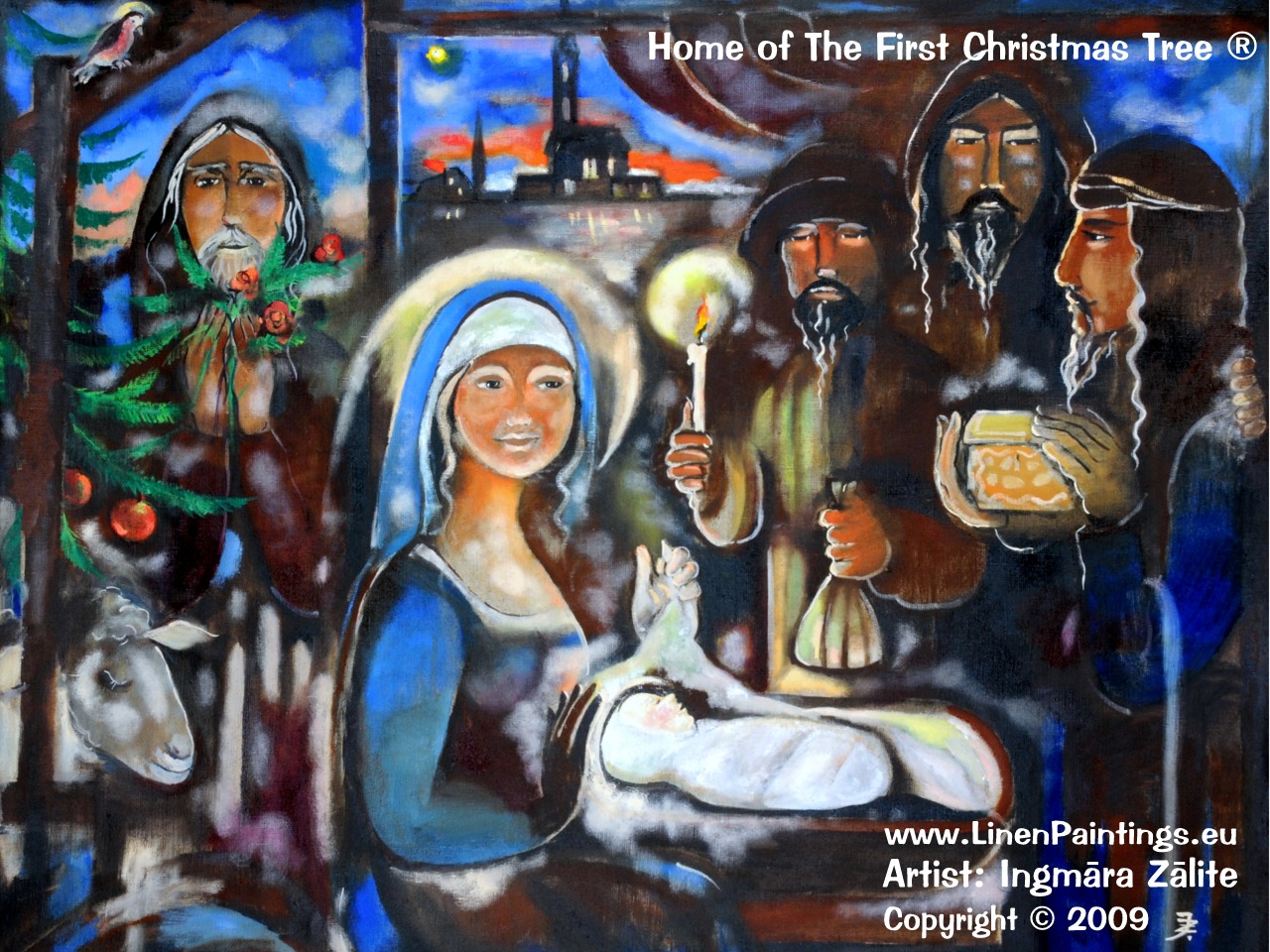
Most families have a Christmas Tree (or maybe even two!) in their house for Christmas. The decorating of the tree is usually a family occasion, with everyone helping. Christmas Trees were first popularised the UK by Prince Albert, the husband of Queen Victoria. Prince Albert was German, and thought that it would be good to use one of his ways of celebrating Christmas in to England.
Holly, Ivy and Mistletoe are also sometimes used to decorate homes or other buildings.
Most villages, towns and cities are decorated with Christmas lights over Christmas. Often a famous person switches them on. The most famous Christmas lights in the UK are in Oxford Street in London. Every year they get bigger and better and thousands of people go to watch the big ‘switch on’ around the beginning of November.
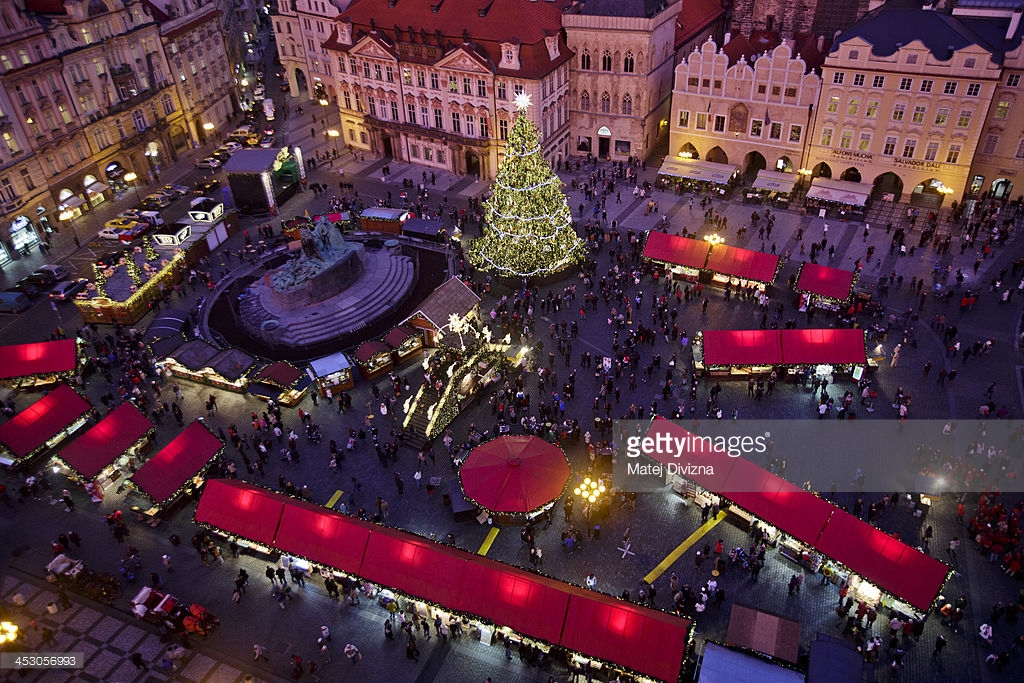
Czeck Republic
USA:
The United States of America has many different traditions and ways that people in celebrate Christmas, because of its multi-cultural nature. Many customs are similar to ones in the UK, France, Italy, Holland, Poland and Mexico.
The traditional meal for Western European families is turkey or ham with cranberry sauce. Families from Eastern European origins favour turkey with trimmings, keilbasi (a Polish sausage), cabbage dishes, and soups; and some Italian families prefer lasagne!
Some Americans use pop-corn threaded on string to help decorate their Christmas Tree!
Australia:
In Australia, Christmas comes in the middle of the summer holidays! Children have their summer holidays from early to mid December to early February, so some people might even be camping at Christmas!
Because it’s so hot at Christmas time in Australia, there are quite often massive bush fires across the country. Many volunteer bush fire fighters are involved in saving people and property and travel from all over Australia to help in other states.

China:
In China, only about one percent of people are Christians, so most people only know a few things about Christmas. Because of this, Christmas is only often celebrated in the major cities. In these big cities there are Christmas Trees, lights and other decorations on the streets and in department stores. Santa Claus is called ‘Shen Dan Lao Ren’ and has grottos in shops like is Europe and America.
In Chinese Happy/Merry Christmas is ‘Sheng Dan Kuai Le or 圣诞快乐’ in Mandarin and ‘Seng Dan Fai Lok or 聖誕快樂’ in Cantonese. Happy/Merry Christmas in lots more languages.
In China, Santa is known as ‘Sheng dan lao ren’ (Traditional: 聖誕老人, Simplified: 圣诞老人; means Old Christmas Man).
One a few people have a Christmas Tree (or celebrate Christmas at all!). If people do have a tree it is normally a plastic one and might be decorated with paper chains, paper flowers, and paper lanterns (they might also call it a tree of light). The Christmas Trees that most people would see would be in shopping malls!
Hong Kong:
In Hong Kong, Chinese Christians celebrate Christmas with Church services in Chinese. At the Anglican Cathedral, some services are held in English, because Europeans who live and work in Hong Kong attend them as well as people from Hong Kong.
In Hong Kong, people also send Christmas cards, many of which are home made using Chinese craft techniques.
Poinsettias flowers and Nativity scenes decorate homes, churches and public places, as well as big red and gold letters from the Chinese alphabet on decorated streamers and paper chains.
Italy:
One of the most important ways of celebrating Christmas in Italy is the Nativity crib scene. Using a crib to help tell the Christmas story was made very popular by St. Francis of Assisi in 1223 (Assisi is in mid-Italy). The previous year he had visited Bethlehem and saw where the stable, where it was thought that Jesus was born. A lot of Italian families have a Nativity crib in their homes.
The city of Naples in Italy is world famous for its cribs and crib making. These are known as ‘Presepe Napoletano’ (meaning Neapolitan Cribs). The first crib scene in Naples is thought to go back to 1025 and was in the Church of S. Maria del presepe (Saint Mary of the Crib), this was even before St. Francis of Assisi had made cribs very popular!
Japan:
Christmas is not widely celebrated in Japan as not many people there are Christians. However, several customs have come to Japan from the USA such as sending and receiving Christmas Cards and Presents.
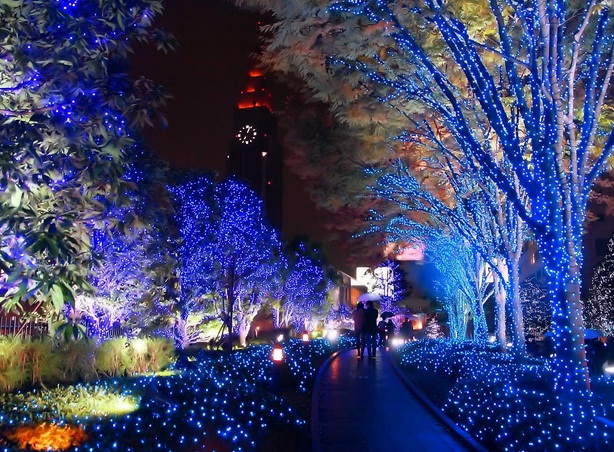
In Japan, Christmas in known as more of a time to spread happiness rather than a religious celebration. Christmas eve is often celebrated more than Christmas Day. Christmas eve is thought of as a romantic day, in which couples spend together and exchange presents. In many ways it resembles Valentine’s Day celebrations in the UK and the USA. Young couples like to go for walks to look at the Christmas lights and have a romantic meal in a restaurant – booking a table on Christmas Eve can be very difficult as it’s so popular!
In Japanese Happy/Merry Christmas is ‘Meri Kurisumasu’. And it’s written in the two Japanese scripts like this; Hiragana: めりーくりすます; Katakana: メリークリスマス.
Greece:
On Christmas Eve, children, especially boys, often go out singing ‘kalanda’ (carols) in the streets. They play drums and triangles as they sing. Sometimes the will also carry model boats decorated with nuts which are painted gold. Carrying a boat is a very old custom in the Greek Islands.
If the children sing well, they might be given money, nuts, sweets and dried figs to eat.
Christmas Trees are becoming more popular in Greece, but they aren’t traditional. Instead most houses will have a shallow wooden bowl with a piece of wire is suspended across the rim. A sprig of basil wrapped around a wooden cross hangs from the wire. Some water is kept in the bowl to keep the basil alive and fresh. Once a day, someone, usually the mother of the family, dips the cross and basil into some holy water and uses it to sprinkle water in each room of the house.

India:
Compared to other religious festivals, Christmas is quite a small festival in India, due to the number of people who are Christians (about 2.3%) compared to people who belong to other religions. Having said this, the population of India is over 1 Billion, so there are over 25 million Christians in India!
Many different languages are spoken in India. In Hindi Happy/Merry Christmas is ‘Śubh krisamas’ (शुभ क्रिसमस); Urdu it’s ‘krismas mubarak’ (کرسمس); in Gujarati it’s ‘Anandi Natal’ or ‘Khushi Natal’ (આનંદી નાતાલ); in Sanskrit it’s ‘Krismasasya shubhkaamnaa’; in Bengali ‘shubho bôṛodin’ (শুভ বড়দিন); in Tamil it’s ‘kiṟistumas vāḻttukkaḷ’ (கிறிஸ்துமஸ் வாழ்த்துக்கள்); in Punjabi it’s ‘karisama te nawāṃ sāla khušayāṃwālā hewe ‘ (ਕਰਿਸਮ ਤੇ ਨਵਾੰ ਸਾਲ ਖੁਸ਼ਿਯਾੰਵਾਲਾ ਹੋਵੇ); in Konkani it’s ‘Khushal Borit Natala’ and in Malayalam it’s ‘Christmas inte mangalaashamsakal’

Romania:
In Romania, Christmas and mid-winter celebrations last from 20th December to 7th January. The 20th is when people celebrate St. Ignatius’s Day. It is traditional that if the family keep pigs, one is killed on this day. The meat from the pig is used in the Christmas meals.
The Christmas celebrations really begin on Christmas Eve, 24th, when it’s time to decorate the Christmas Tree. This is done in the evening of Christmas Eve. In Romanian, Christmas Eve is called ‘Ajunul Craciunului’.
Carol singing (known as ‘Colindatul’) is also a very popular part of Christmas in Romania. On Christmas Eve children go out carol singing from house to house performing to the adults in the houses. They normally dance as well. The children get sweets, fruit, traditional cakes called ‘cozonaci’ and sometimes money for singing well. Adults go carol singing on Christmas Day evening and night.
A traditional Romanian Carol is the ‘Star Carol’. The star, made of colored paper and often decorated with tinsel, silver foil and sometimes bells, is put on a pole. In the middle of the star is a picture of baby Jesus or a nativity scene. Carol singers take the star with them when they go carol singing. The words of the Star Carol are:
“The star has appeared on high,
Like a big secret in the sky,
The star is bright,
May all your wishes turn out right.”
Other popular carols to sing include ‘Oh, What Wondrous Tidings’ (‘O, ce veste minunata’) and ‘Three Wise Men coming from the East’ (‘Trei Crai de la rasarit’).

Germany:
A big part of the Christmas celebrations in Germany is Advent. Several different types of Advent calendars are used in German homes. As well as the traditional one made of card that is used in many countries, there are ones made out of a wreath of Fir tree branches with 24 decorated boxes or bags hanging from it. Each box or bag has a little present in it. Another type is called a ‘Advent Kranz’ and is a ring of fir branches that has four candles on it. This is like the Advent candles that are sometimes used in Churches. One candle is lit at the beginning at each week of Advent.
Christmas Trees are very important in Germany. They were first used in Germany during the Middle Ages. If there are young children in the house, the trees are usually secretly decorated by the Mother of the family. The Christmas tree was traditionally brought into the house on Christmas eve, and during that evening the family would read the Bible and sing Christmas songs such as O Tannenbaum, Ihr Kinderlein Kommet and Stille Nacht (Slient Night).

France:
In France, a Nativity crib is often used to help decorate the house. French cribs have clay figures in them, not wooden ones. During December, some towns and cities such as Marseilles have fairs that sell Nativity figures. As well as having the normal Nativity figures in them, French scenes also have figures such as a Butcher, a Baker, a Policeman and a Priest.
In French Happy/Merry Christmas is ‘Joyeux Noël’. In Breton (spoken by some people in Brittany, Northern France) it’s ‘Nedeleg Laouen’ and in Corsican it’s ‘Bon Natale’. Happy/Merry Christmas in lots more languages.
Yule Logs made out of Cherry Wood are often burned is French homes. The log is carried into the home on Christmas Eve and is sprinkled with red wine to make the log smell nice when it is burning. There is a custom that the log and candles are left burning all night with some food and drinks left out in case Mary and the baby Jesus come past during the night.
Austria

Mexico:
In Mexico, Christmas is celebrated from the December 12th to January 6th.
From December 16th to Christmas Eve, children often perform the ‘Posada’ processions or Posadas. Posada is Spanish for Inn or Lodging. There are nine Posadas. These celebrate the part of the Christmas story where Joseph and Mary looked for a room in an Inn. For the Posadas, the outside of houses are decorated with evergreens, moss and paper lanterns.
————————————————————————————————————-
I hope this helped you find out more about Christmas around the world!
– Yasmin